The Critical Role of Pronunciation in Language Learning
Learning a new language involves far more than memorizing vocabulary and grammar rules. Pronunciation — the ability to produce the correct sounds in the correct sequence and with the correct intonation — is what transforms passive knowledge into the ability to actually communicate. For a language like Kinnauri, which has unique phonemes, tonal elements in certain dialects, and sounds that do not exist in Hindi or English, getting pronunciation right is both particularly important and particularly challenging without audio guidance. This is precisely why Bol Kinnauri has invested significantly in its speech and audio features.
Text-to-Speech Technology — Hearing Kinnauri Come Alive
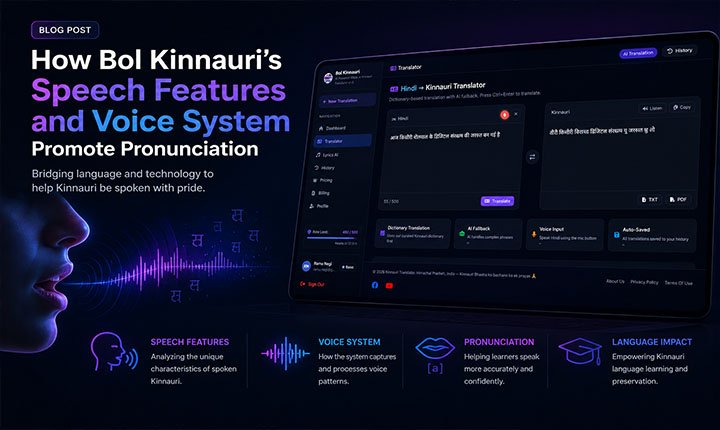
The Text-to-Speech (TTS) system integrated into Bol Kinnauri converts written Kinnauri translations into natural-sounding spoken audio. The moment a translation is completed, users can click the speaker icon to hear the translated text read aloud. This feature serves several critical functions:
- Pronunciation modeling: Users hear exactly how the translated phrase should sound, giving them an auditory model to imitate
- Confirmation of accuracy: Hearing the translation spoken aloud often helps users verify whether the output sounds natural and correct
- Accessibility: For users with limited literacy in Devanagari script, audio output provides an alternative way to access and use the translated content
- Memory retention: Research in language acquisition consistently shows that learners who engage both visual and auditory memory pathways retain vocabulary significantly more effectively than those who rely on reading alone
Voice Input — Speaking to Translate
In addition to Text-to-Speech output, Bol Kinnauri offers a voice input feature that allows users to speak their Hindi text directly into the microphone rather than typing it. This is particularly useful in situations where typing is inconvenient, such as when a user is on the move, when they want to translate a spoken phrase they have just heard, or when they are elderly or have limited keyboard familiarity. The voice recognition system transcribes the spoken Hindi text and immediately passes it to the translation engine, streamlining the entire workflow from speech to translation to audio output.
The Importance of Audio in Kinnauri's Specific Case
Kinnauri presents unique challenges for written-only language learning that make audio features especially important. Unlike Hindi, which is written in the well-standardized Devanagari script and has abundant audio resources available online, Kinnauri lacks a universally accepted written form. Different researchers and communities have used different systems to represent Kinnauri sounds in writing, leading to inconsistency. In this context, audio is often more authoritative than text — hearing how a word is pronounced by a native speaker or a carefully calibrated TTS engine provides clarity that written transcription alone cannot always deliver.
Future Plans — Native Speaker Audio Archives
While the current TTS system provides high-quality audio output, the team behind Bol Kinnauri recognizes that nothing can fully replace the authenticity of real human voice recordings from native speakers. There are active plans to develop a native speaker audio archive as part of the platform — a growing library of voice recordings contributed by fluent Kinnauri speakers from different valleys and dialect areas. This archive will serve as both a pronunciation reference and a historical linguistic document, capturing the true sound of the language as it is spoken today by its native community.
Practical Applications of the Speech Features
The voice and audio features of Bol Kinnauri have practical applications across a wide range of real-world scenarios. Teachers can use audio playback to teach students correct pronunciation in language classes. Tourists can listen to common phrases before speaking them with local residents in Kinnaur. Researchers can use the TTS output as a preliminary phonetic reference while conducting fieldwork. Filmmakers and documentary producers working on Kinnauri cultural projects can use the platform to verify pronunciation for scripts and narration. And everyday users can simply enjoy hearing the beautiful sounds of the Kinnauri language in a convenient digital format.
Conclusion
The speech and audio features of Bol Kinnauri transform the platform from a text-based translation tool into a genuinely immersive language experience. By making it possible to hear Kinnauri spoken accurately and to translate using your own voice, the platform removes two of the biggest barriers that language learners face: pronunciation anxiety and typing inconvenience. These features reflect a deep commitment to making the Kinnauri language not just readable but truly audible — and in doing so, they help keep the voice of Kinnaur alive for all who wish to hear it.
Comments (0)
Login Required to Comment
Please sign in to share your thoughts on this article.
Sign In to Comment